

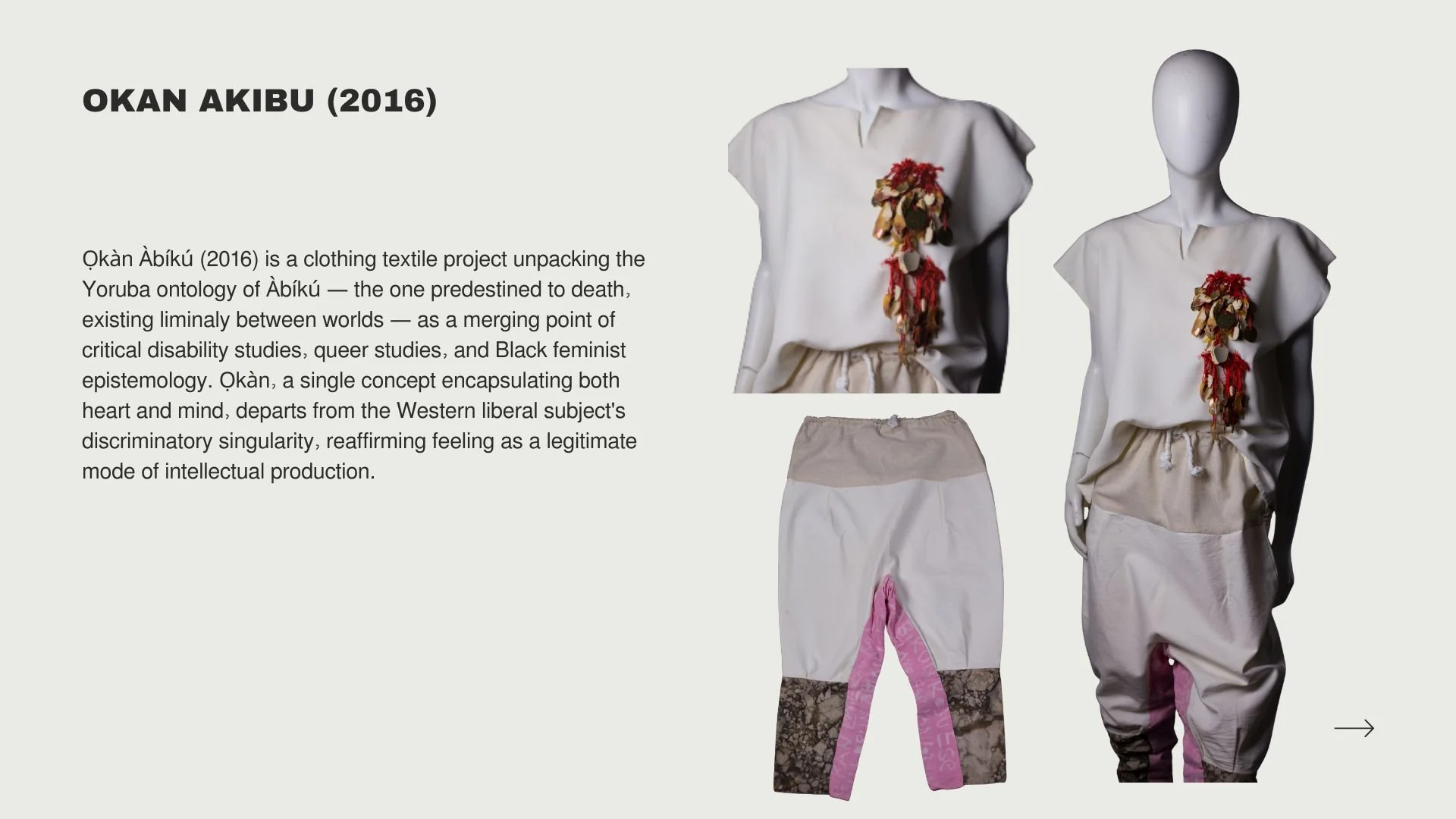
Ọkàn Àbíkú (2016) is a design piece I created to unpack the Yoruba ontology of Àbíkú as a merging point of critical disability studies, critical queer studies, and black feminist epistemology. Àbíkú is a Yoruba ontology that describes the one who is predestined to death. Àbíkú are conceptualized as people in between worlds who haunt their parents with their deaths or with the threat of their death. Those who live beyond the first initial months of birth exist in a liminal space in between worlds, constantly on the verge of death or transition. Ọkàn means mind in Yoruba but also heart. Okan Abiku is thus the heart/mind of the one in between world. The work pushes against the dichotomous dualism separating heart and emotionality from mind as well as body, a separation that is at the core of western epistemology. Ọkàn Àbíkú undoes the thinking/feeling dichotomy set forth by the likes of Descartes and reaffirms the need for a unified epistemology that recognizes feeling as an intellectual mode of production.
In the piece, traumatic experiences felt through the heart, mind, and body at once converge into a materialized form of clothing that is informed by both narrative and critical theory. Ọkàn Àbíkú is an expression of the radical ambivalence of queerness that Jose Munoz describes in Cruising Utopia as “the rejection of here and now and an insistence on potentiality or concrete possibility for another world” (Munoz 1). It builds on his hope methodology of a “backward glance that enacts future vision” (Munoz 4). I took experiences of ableism and abuse, and created a suit meant to be at once a form of protection and an expression of my pain and journey towards healing.
The execution of the work comes to encapsulates many liminalities and desires for translation. The design is in white and red, a reference to Sango and the evocation of the strength of the god of thunder. Beaded across the heart of the tunic are handmade beads that are at once references to the talisman of Yoruba hunters. Each bead is a piece of waste material, including old fruit and pill bottles. Through the use of decaying organic material I engage ephemerality and the realities of my own humanness and sense of being in a body with chronic illness. Each of the beads were cut, gilded with gold paint or copper leaf, and sanded.