Decolonial Design Journal: July 2026
Commission with STIR World and Nieuwe Instituut (the National Museum of Architecture, Design and New Media in the Netherlands)
For the next few months, I’ll be working on a commission with Nieuwe Instituut and STIR for Design Drafts #4: Design Dialects. Design Drafts is a writing and publishing network that investigates what it means to write about design today, pairing selected writers with different magazines and platforms each edition. This year’s call, Design Dialects, is asking what happens to design knowledge as it travels through migration and digitization.
My proposal is about the question of documentation and legitimacy within indigenous design, and indigenous data sovereignty. I’m working through how indigenous knowledge resists the demand to be made legible. What gets asked to translate itself into archives, records, and institutional formats in order to be recognized as “design,” and what’s lost or protected in the refusal.
If you would like to follow along with my writing process and some of my thoughts as I put this commission together, I suggest you subscribe to the premium Substack, or keep an eye out for when I announce the paid subscription on my website, where I’ll be sharing writing-in-progress for longer-form projects.
What Does It Mean to Decolonize design?: Dismantling Design History, 101 by Anoushka Khandwala
Currently putting together an Indigenous and Vernacular graphic design course 👼🏿, and it led me to revisit this wonderful text I read during my MFA program.
If you are an aspiring decolonial designer, or you’re curious about what decolonial design even is, I highly suggest you read this. I found it near the end of my MFA, at a point where two years of isms in the program had me doubting I knew what I was talking about, despite over a decade already spent as a decolonial scholar. Reading it felt like a gentle hug. It affirmed everything I already knew, and more than that, it told me I wasn’t alone in asking these questions. I’ve taught it every chance I’ve had since, at NYU’s Integrated Design and Media program and at Virginia Commonwealth University.
Navigating self-worth as a Decolonial designer in the era of capitalism
I’ve got a lot going on personally with my work. And it’s bringing up deep, important, but sometimes scary feelings around self-worth, being understood, and “being seen” (that last one is more and more becoming a phrase that irritates me and feels like a capitalist co-option of our vulnerability).
I have a couple of coping mechanisms for moments of transition like this.
First, through learning about compassionate neuroplasticity, I gained an education in trauma-informed care that has served me incredibly in my work and shaped my pedagogy as a designer, including my two years at Our Just Future, a trauma-informed social housing organization based in East Portland, Oregon, USA. But probably the most out there modality I engage in on a regular basis is astrology. I see it as just one of the many meaning-making methodologies inside my decolonial design toolkit. Whole house astrology has begun to gain a kind of universalism that makes it a potential transition modality for people. I think more and more people are, through this meaning-making form of astrology, buying into the idea that the material (planets) has an impact on the immaterial (emotions, inclinations, seemingly unpredictable events), which in turn has an impact on the material again (life circumstances and outcomes). Though I feel vulnerable about it, I am opening up to sharing more of how I use this methodology, and soon you’ll be able to access a resource for that.
As I’ve been using astrology to work through this moment, one of the topics that keeps coming up is self worth, specifically in how I speak about my work. I think it’s really about value systems: when will all the work I’ve done be valued, and when will I gain the respect and kudos I expect from having done such rich, complex, and deeply thought-out work for so long.
There’s a moment I experienced this month that helped me process and gain more clarity:
I was scrolling Instagram, which is generally a bad idea, and I saw a video a friend reposted of a non-Nigerian artist in residence at the GAS Foundation, a residency run by Yinka Shonibare. Shonibare is someone I deeply admired and read quite a bit in my early days as an undergraduate research fellow doing studies on fashion design during his heyday of popularity. In more recent times I have grown incredibly critical of his approach to art and accessibility. It started with a Q&A in 2020 before his residency launched, where I asked how, given the emphasis on cross-cultural dialogue and importing residents from outside Nigeria, he was going to ensure appropriation and extraction didn’t become a theme of the residency.
He responded with what I found to be a very uncritical and somewhat dismissive answer: “Artists don’t extract, artists don’t appropriate.” Which is not only factually untrue, but sidesteps the larger question of the dangers of globalization-centered arts institutions. I can understand what investments or experiences might have led him to that statement. From what I can gather, he comes from a well-to-do background, and as a “British Nigerian” who had immense fame in the 2010s in institutions and galleries, he seems to be in the legacy-production era of his career, and so I imagine has deep investments in remaining legible to global institutions, specifically white European-led ones.
This is, of course, completely counter to my approach, as you could probably gather from the summary of my upcoming commission. I feel deeply wary towards the historic and ongoing system and economy of white presence inside Nigeria’s contemporary art system. It goes back to the beginning of contemporary art here, connected to processes of extraction and appropriation driven by Negrophilia in Europe that led to the erasure of indigenous Africans’ contribution to the global art canon, specifically to conceptual art and abstraction. I can talk about that forever, but I have another writing commission focused specifically on these histories, which I hope will be out in the next couple of months.
So, with that context for why anything GAS Foundation is a little “activating” for me: back to the Instagram post.
It was a post from a resident, not Nigerian, sharing a bioplastic lamp project. It felt a little bit bristly for me, because it’s an idea I’d had myself several months ago, one I haven’t been able to physicalize yet because I’m waiting for more depth to come through about it.
Importantly, this person’s project used a herb that is very sacred to me, included in a superficial/surface way that lacked the depth of approaching indigenous material knowledge as a conversation with kin. No shade to this person; they don’t have the context or background, genealogy, or experiences to make it a more in-depth inquiry. It would not be their place to do that work in that way.
But I felt some type of way watching someone clearly less experienced in this arena than I am (I’ve been doing this work for more than a decade) have the beauty and benefit of a gorgeous rammed-earth space in Ijebu to do their work, and access to beautiful farmland. This brought up a sense of insecurity for me, because on one hand, I want access to those resources, and I know how much they’d support my work. On the other hand, including the herb in a surface-level/passive way and presenting the work the way it was presented, as a form of Instagram content people see for a minute and a half and forget, runs directly against my values around the reverence and sacredness I feel toward my indigenous material knowledge and the sacred work I do with indigenous non-human kin.
So what I had to sit with was the internal tension: knowing how valuable my work is, knowing how much acknowledgment it’s worthy of, and being unwilling to play the existing, conventional games of “visibility” because of the knowledge of how valuable the work is. It is the very thing that says this work deserves to be seen that is also keeping me from sharing and displaying it in the most conventional ways of getting eyes on one’s work.
I really needed to sit with those feelings of rejection and resentment. The poetry is that the sacred herb this person was engaging has taught me, in my years of intimacy with it, to be present with anger in the face of exclusion, that resentment can be a way of honouring what is sacred.
But the most beautiful part of processing this experience has been this: I let myself be present in the emotions, and eventually it brought me to a place of apologizing to myself for how upset I even got. I allowed myself to be present with the worry that if I stay this committed to non-neoliberal, indigenous-grounded values, and let that guide everything I do, I won’t have access to any of the resources that would make this easier. That no one will see me, and no institutions will support work that deserves support, because I’m making paradigm shifts and doing hard infrastructural work behind the scenes. What I realized is that part of the resentment was anxiety that institutions only support what’s most easily visible and legible, and that’s a form of black-and-white thinking which creates a reality I am unable to thrive in. It might be the exception to find spaces with these resources that want to prioritize this kind of deep work, but not the rule that it will never happen.
After sitting with that, along with the values and perspectives that might be informing this specifically in Nigeria, I came across this:
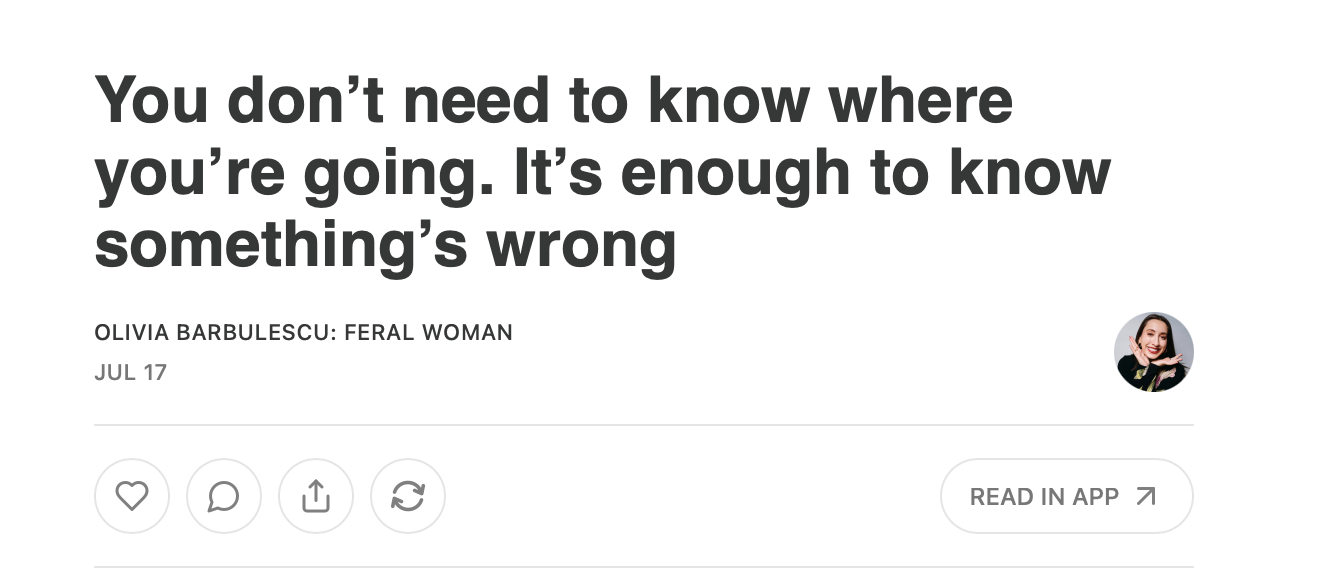
It felt like a message from the gods, because I was in this exact moment of needing to remember that knowing something is not the right fit, a certain approach, methodology, value system, or way of doing things, is enough. I don’t have to have the answer for how I’m going to fix this or build an alternative right away, which is always what my anxious mind wants to do when activated. I can just sit in the affirmation that something is not the right path for me.
Not long after that, I saw a post from an amazing company that runs a model inspired by communist conflict theory.
It was another validation that doing things your own unique way, aligned with your values but not the standard, is challenging. It’s challenging when the standard way of communicating or designing isn’t a fit for you. But that doesn’t mean you can’t create the infrastructure, the circumstances, the container that fits you, and reap the material rewards of doing something on your own terms. This company felt like the creator’s way of nodding at me: there is a path here, a resource, a sustainable path, yours will just look different from other people’s, but it will be more fulfilling than trying to do it the conventional way that isn’t even what you were put here to do.
This note feels vulnerable, but I think it’s important for younger artists and designers to hear this from people who are seasoned, who’ve kept making their own path, because the anxiety around the “how,” once you have the vision, is probably where most of us get tripped up.
I hope life sends you an affirming sign today.
wishing you well-being
x mukhtara